

More Than a Martial Art.
A Complete Development
System for Your Child.
Capoeira combines movement, music, culture, and community into one powerful practice. Watch your child grow physically, socially, emotionally, and intellectually. One class at a time.
You won't find this anywhere else.
A complete practice that builds strength, body control, and awareness, while developing confidence, creativity, and emotional growth. Students also connect to culture, history, music, and the deeper values of freedom, resilience, and expression.
Why This Works.
And Why Nothing Else Comes Close.
Most programs teach movements. We build people. After 30 years of training, teaching, and developing students across four continents, this method is the result of everything learned, and everything that actually works.


I Started Without Knowing Capoeira Would Change My Life Forever.
In 1996, I started Capoeira in São Paulo, Brazil. My teacher was 17 years old with one year of experience. We trained almost every day, three classes a week, right at the end of our street. Outside of class, I practiced constantly on the concrete in front of my house. That's where I developed my acrobatics. That's where the method was born.
We had almost no information. No internet. No tutorials. Every movement we learned was precious. We trained with focus, repetition, and deep curiosity. That scarcity created something powerful: we valued everything we learned.
That value created commitment. That commitment created skill. That skill created a life dedicated to this art.
When something is rare, you value it more. I teach students to understand the value of Capoeira so they stay consistent and committed for life.
When students understand what they are learning and why it matters, they stop quitting. They stay. They grow. We don't just teach movements, we teach the meaning behind them.
My teacher made me fall in love with Capoeira. That emotional connection is what kept me training through every obstacle. We create that same connection in every student, because love is the only thing that sustains long-term practice.
We didn't just repeat movements. We repeated with intention, attention, and understanding. That is the difference between someone who trains for years and someone who truly develops. Awareness transforms repetition into mastery.
A Clear Path. Not Random Movements.
Every class follows a deliberate sequence. Students don't just learn Capoeira, they build the capacity to play it, understand it, and carry it for life.
Coordination, body awareness, control, strength, endurance, power, and speed. Before any Capoeira movement, the body must be ready.
Ginga, basic kicks, escapes, floor confidence, and safe movement principles. These are the building blocks everything else rests on.
How to ask and answer in the jogo. Timing, interaction, awareness of your partner, rhythm, and flow. This is where Capoeira becomes a conversation.
Traditions, rituals, music, and culture. Capoeira is not just a physical practice, it is a living art form with deep roots in Brazilian history and African heritage.
The goal is not a cool move. The goal is to give students tools so they can play Capoeira anywhere, continue growing for years, and enjoy the process for life.
- Clear breakdown of every movement
- Understanding before complexity
- Progressive challenge that respects the body
- Technique, timing, and depth
- High volume of movement through games
- Repetition without boredom
- Strength and coordination built naturally
- Confidence through joyful exploration
30 Years. 30+ Teachers. Countless Lives Changed.
This method has been tested in real classrooms, with real students, across four continents. The results speak for themselves.
This method produced extraordinary capoeiristas, Lobinho, Perna, James, Cicinho, Grazi, Nego Bruce, Esguicho, Felina, Guerreiro, and many others who went on to teach, perform, and carry this art around the world. They are not just students. They are the proof.
This is the method your child will train under.
Not a franchise. Not a curriculum downloaded from the internet. A living method, built from 30 years of real experience, refined in real classrooms, and proven by real results.
Age-Specific Progressions
Each age group has a curriculum designed around what children at that stage are developmentally ready to learn.
Ages 3–4: Foundations & Play
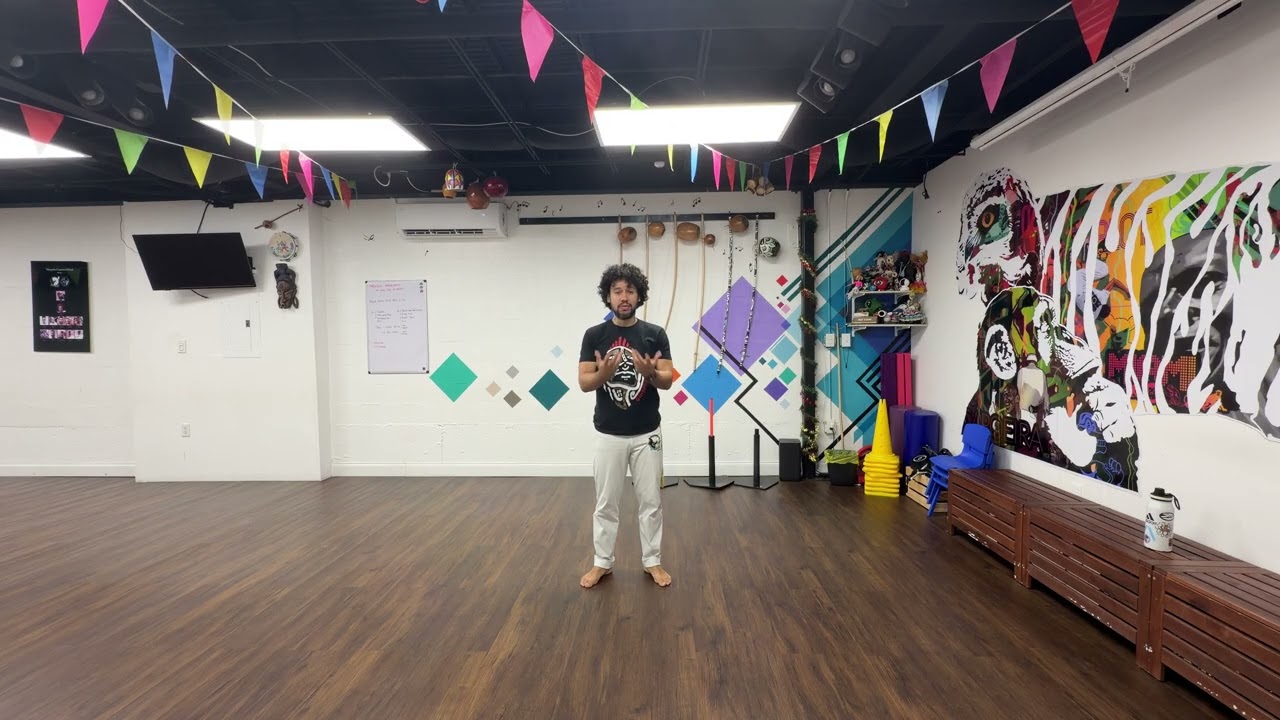
At this age, movement IS learning. We focus on body awareness, coordination, and a love of movement through Capoeira-inspired games. No pressure, no performance just joyful exploration.
- Walking forward, backward, sideways
- Running and stopping with control
- Jumping and hopping
- Squatting and standing
- Animal walks: Crab, Lion, Monkey
- Table position
- Basic Ginga (mimicking the move)
- Cocorinha (basic squat escape)
- Negativa (simplified)
- Meia lua de frente (basic front kick)
- Basic "dragon tail" (leg sweep intro)
- Assisted bridge (when ready)
- Wall handstand (facing the wall)
- Baby handstand hops (intro to au)
- Move to the rhythm of the music
- Learn simple call-and-response songs
- Introduction to Capoeira instruments by name
- Clapping basic rhythms
Ages 5–8: Basic Capoeira Movement
Children at this age are ready to learn real Capoeira technique. We introduce the foundational moves, first partner interactions, and the beginning of the musical culture.

- Ginga (full movement)
- Cruz (ginga variation)
- Cocorinha
- Esquiva lateral
- Negativa
- Negativa trocada
- Bases: Table, broken table, pyramid, camaleão, banana, baqueta, chair, eagle
- Compass walk (hand-walk circles)
- Tornado (low turning floor movement)
- Tesoura (low and high)
- Meia lua de frente
- Queixada
- Dragon tail (meia lua de compasso leg circles only)
- Cabeçada
- Au (cartwheel)
- Assisted handstand (wall/mat)
- Macaco (intro)
- Ponte (bridge)
- Double kick (meia lua + armada)
- Au over negativa or tesoura
- Passagem na tesoura
- Au + cocorinha + negativa + rolê
- Any kick + transforma + cocorinha + macaco
- Partner: Cruz sequence
- Partner: Respond with cabeçada
- Clap basic rhythms
- Start learning instrument names
Ages 9–12: Sequences, Flow & Partner Work
At this stage, children are ready to combine movements, improve flow, and develop real game intelligence through partner interaction and more complex acrobatics.

- Ginga lateral variations
- Partner ginga
- Costura
- Negativa enrolada
- Negativa de costas
- Resistência intro
- Esquiva baixa intro
- Armada
- Queixada + armada
- Meia lua de compasso
- Bençao
- Martelo
- Joelhada (defense of cabeçada)
- Rasteira (intro)
- S-batido
- Ponte
- Entrada da ponte
- Handstand kickover (wall)
- Bananeira de cabeça
- Corta-capim
- Macaco (level 1)
- Currupio
- Au agulha
- Bico de papagaio (intro)
- Queda de rins (intro)
- Parafuso
- Meia lua de frente + au
- Negativa + meia lua de compasso
- Au + negativa
- Cruz respond with cabeçada
- Defend cabeçada with joelhada
- Block joelhada
- Double kick escape with cocorinha + macaco + bençao
- Use negativa to escape the bençao
- Au over negativa
- Double kick + queixada + finta au + au
- Double kick + baixa + martelo
- Meia lua de frente step lateral cocorinha + macaco
- Learn to sing the chorus of songs
- Introduction to playing pandeiro (basic rhythm)
- Learn more complex Capoeira songs
Teens 13–14+: Advanced Technique & Strategy
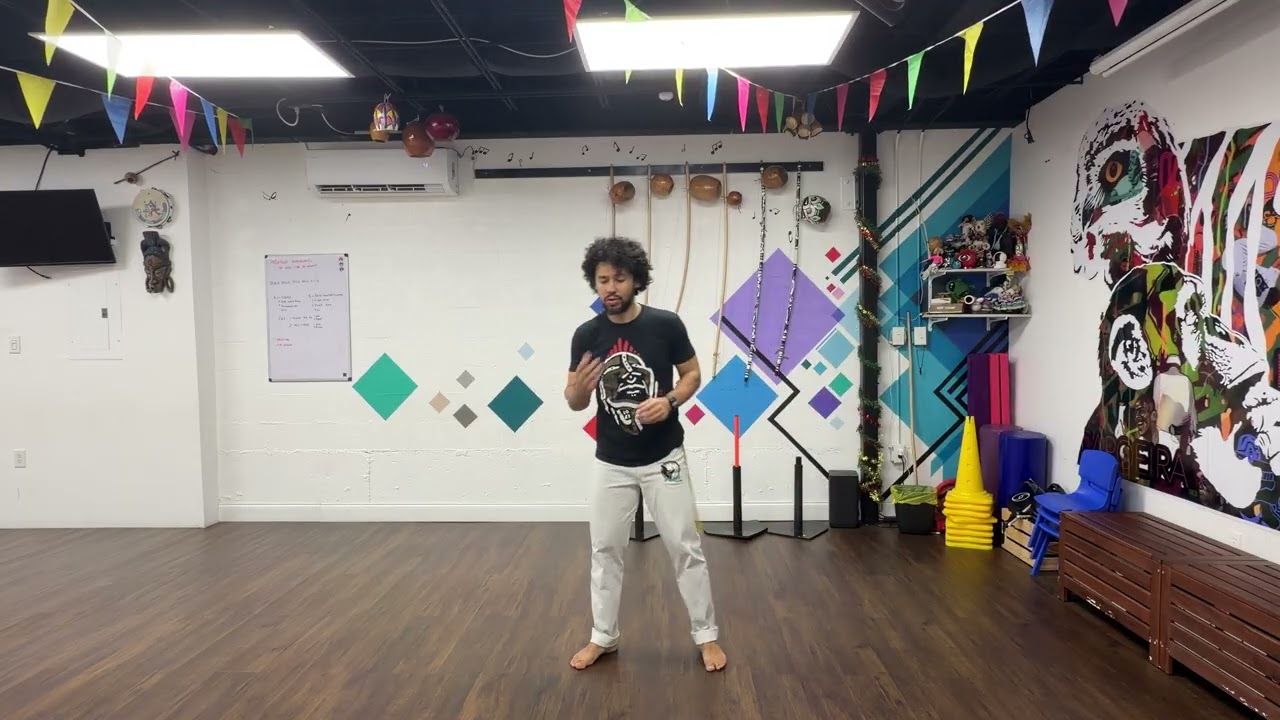
Teens are ready for the full depth of Capoeira advanced acrobatics, complex partner sequences, musical mastery, and the strategic intelligence of the roda game.
- Ginga lateral and back variations
- Finta armada, finta meia lua de compasso, finta queixada
- Esquiva com balanço variations
- Passo à frente, negativa espalhada
- Negativa angola + negativa enrolada
- Esquiva do martelo
- Queixadas together
- 2x meia lua de compasso, 2x armada
- Chapa, Parafuso, Camaleão
- Attacks using arms: Galopante, espelho, godeme, cutilo
- Rasteira, Vingativa, Banda de costas
- Bananeira walk & hold
- Au amazonas, Au de cabeça
- Volta na ponte, Currupio
- Macaco, Au agulha
- Giro de mão, Bico de papagaio
- Au coluna, S-dobrado, Au sem mão
- Au chibata, Macaco em pé
- Au pra frente, Passa pescoço
- Relogio, Giro de cabeça
- Au coluna trocado, Meia lua de coluna
- Helicopter, Volta por cima, Au CDO
- Au to ponte, Negativa de costas to ponte
- Finta meia lua de compasso to ponte
- Ponte + corta capim, Ponte + queda de rins
- Rasteira to queda de rins
- Queda de rins fechada/batida
- Au + queda de rins
- Complex partner sequences with all techniques
- Armada escape with cruz, then bençao
- Resistencia, meia lua de compasso, cocorinha
- Clap and respond to chorus
- More complex pandeiro rhythms
- Start learning agogô, reco-reco
No Age Limit. No Experience Required.
Just Show Up.
Capoeira doesn't ask you to be athletic, flexible, or young. It meets you exactly where you are and builds from there. We have students from age 3 to 60+, and every single one of them started from zero.
Capoeira Is Not a Fast-Learning Activity. That Is the Point.
Many parents enroll their child expecting visible results within a few weeks. We understand that impulse. But Capoeira works differently from most activities, and that difference is exactly what makes it so valuable.
Real progress in Capoeira comes from consistency over time. The movements are complex. The music takes patience. The game intelligence develops slowly. A child who trains for two years will carry skills, confidence, and habits that a child who trained for two months simply cannot have.
This is not an excuse for slow progress. It is the nature of deep learning. The children who stay are the ones who grow the most. And the parents who understand this become the most powerful support their child can have.
Most activities develop one skill. Capoeira combines four complete disciplines into a single class.
Four Disciplines. One Practice.
Most activities develop one skill. Capoeira combines four complete disciplines into a single class. Your child does not choose between them. They get all four, every session.
Self-Defense Through Awareness, Not Aggression
Capoeira teaches children to read a situation, move with intention, and respond with control. The goal is never to hurt. It is to be aware, to be calm, and to be capable. Children learn kicks, escapes, and partner interaction through play. They develop confidence without ego.
Movement That Builds Grace, Rhythm, and Expression
The ginga is the foundation of Capoeira. It is a constant, flowing movement that never stops. Children learn to move their entire body in rhythm, to express themselves through motion, and to develop the kind of physical grace that shows up in everything they do. It is not choreography. It is freedom.
Live Instruments, Songs, and a 500-Year Tradition
Capoeira is never practiced in silence. The berimbau sets the pace. The atabaque holds the rhythm. The pandeiro fills the space. Children learn to clap, sing, and eventually play instruments. They connect to Brazilian and African musical traditions that are unlike anything else they will encounter. Music is not a bonus. It is the heartbeat of the art.
Strength, Flexibility, and Body Control Built Progressively
From the first cartwheel (au) to handstands, backbends, and advanced flips, Capoeira builds acrobatic ability step by step. No child is pushed beyond what they are ready for. The progression is patient, structured, and safe. Children develop real physical strength and body confidence that carries into every sport and activity they try.
Every class your child attends, they practice all four. Not one at a time. All four, together, every session.
How students progress, what the Batizado is, and what Vadeia Miami looks like in real life.
A Clear, Visible Progression
Each belt represents real growth. Students earn their next belt through points, attendance, and demonstrated skill. Not just time.
Foundation movements, basic ginga, first escapes, first kicks
Sequences, partner work, basic acrobatics, music intro
Flow, strategy, advanced acrobatics, game intelligence
Leadership, teaching, cultural mastery, roda presence
Path to Teacher Level and Mestre. The journey continues.
All 12 Levels. Every Step.
Kids and teens progress through 12 belt levels, each with a specific color combination. Every belt is earned through points, attendance, and demonstrated skill.
Belt Ceremonies. Every Year.
The Batizado is the most important event in Capoeira. Students receive their first belt, families celebrate together, and the community grows stronger.
The Batizado is the annual belt ceremony where students are officially baptized into Capoeira. They play in the roda with a visiting Mestre and receive their first or next belt.
All students, families, and invited Mestres from around the world. It is a celebration of the entire school. Everyone who trained that year is part of it.
Once a year. Students prepare for months. The belt is not just given. It is earned in the roda, in front of the community, on that day.
See What We Do. In Real Life.
Vadeia Miami is our annual event where students of all ages play Capoeira together. This is what the training builds toward. Watch the video below to see it.

Moments From Past Batizados
Click a year to see the photos from that ceremony.
The point system teaches children that how you show up matters as much as what you can do.
Points Reward Character, Not Just Technique
The point system teaches children that how you show up matters as much as what you can do.
If you reach half your goal, you'll get a small prize for your effort. If you reach your goal and then start behaving badly, you will lose all your points. Extra points carry over to the next belt goal.
Beyond kicks and acrobatics, Capoeira develops your child across six dimensions that shape who they become.
What Your Child Actually Gains
Beyond kicks and acrobatics, Capoeira develops your child across six dimensions that shape who they become.
Balance, coordination, flexibility, strength, agility, and body awareness. Children develop a strong, capable body through movement that feels like play not exercise.
Learning to fall and get back up literally and figuratively. Capoeira builds the ability to handle frustration, manage fear, celebrate others, and stay calm under pressure.
Portuguese language, Brazilian history, African roots, and the philosophy of Capoeira. Children develop an open, curious mind toward other cultures and ways of being in the world.
Music theory, rhythm, memorizing sequences, reading a partner's movement Capoeira is a full cognitive workout that improves memory, pattern recognition, and strategic thinking.
Understanding body position, distance, timing, and direction in relation to another person. This spatial awareness is foundational for mathematics, reading, and all physical activities.
What your child learns in class shows up everywhere else in their life.
Skills That Transfer to Everything
What your child learns in class shows up everywhere else in their life.
Learning sequences, listening to music, and following instructions trains the attention span. Parents consistently report improved concentration in academic settings.
Standing in the roda, playing in front of others, and receiving feedback builds the kind of confidence that shows up in classrooms, friendships, and new situations.
Children develop a strong, upright posture and an awareness of how their body moves through space essential for health, athletics, and self-presentation.
Capoeira teaches children that difficulty is part of growth. Falling is part of learning. This mindset try, fail, adjust, try again transfers directly to every challenge in life.
The culture of Capoeira is built on mutual respect. Children learn to honor their partner, their teacher, and themselves a foundation for healthy relationships throughout life.
Music, movement, and the freedom of the roda give children a healthy outlet for self-expression. They learn to communicate who they are through their body, voice, and presence.
Every child's journey is unique, but here's a realistic picture of what growth looks like across the first year.
What to Expect Over Time
Every child's journey is unique, but here's a realistic picture of what growth looks like across the first year.
- Learns the basic ginga (the foundation of all movement)
- Starts to understand the class structure and rhythm
- Makes first connections with other kids
- Begins to recognize Capoeira songs and instruments
- Builds body awareness and spatial confidence
- Learns first kicks, escapes, and basic acrobatics
- Starts partner interaction the beginning of the game
- Begins earning points through behavior and attendance
- Noticeably more coordinated and body-aware
- Starts asking to practice at home
- Plays in the roda for the first time
- Combines moves into sequences
- Earns their first belt a real milestone
- Begins to understand the music and its role in the game
- Focus and discipline visible outside of class
- Moves with confidence, creativity, and intention
- Understands the culture, language, and values of Capoeira
- Helps newer students becomes a role model
- Noticeably more focused, resilient, and socially confident
- Capoeira is part of who they are
Not just what we teach, but what it feels like to be in class.
What Your Child Experiences
Not just what we teach but what it feels like to be in class.
Movement games that build coordination, attention, and energy kids don't even realize they're training
Age-appropriate moves taught step by step ginga, kicks, escapes, acrobatics always with context and purpose
Practicing with a partner builds trust, communication, and the ability to read another person's movement
Clapping, singing, and learning instruments music is the heartbeat of Capoeira and develops rhythm, memory, and cultural connection
The circle where everything comes together kids play, express themselves, and experience the full magic of Capoeira
Why it matters: Every class is structured but never rigid. Children learn discipline through engagement not through fear or pressure. The goal is for every child to leave class feeling energized, proud, and excited to come back.
The most powerful learning happens when children are engaged, not controlled.
Discipline Through Play, Not Fear
The most powerful learning happens when children are engaged, not controlled.
Children are not small adults. They learn through movement, play, repetition, and joy. When a child is having fun, their brain is open, their body is engaged, and real learning happens.
At Evolve Miami, we don't use rigid drills or authoritarian control. We use structure within freedom clear expectations, consistent boundaries, and an environment where children feel safe to try, fail, and grow.
Discipline is not something we impose. It's something children discover through the practice itself. When they see their own progress when they land a move they've been working on, when they play in the roda for the first time they become self-motivated.
"The child who is given the freedom to explore within safe boundaries develops far more discipline than the child who is simply told what to do."
. Mestre Cabeção, Evolve Miami TeamResearch shows that play-based learning produces deeper, more lasting results than rote instruction. Capoeira is structured play every game has a purpose.
Clear rules and consistent structure give children the safety to take risks, make mistakes, and grow. Our class rules are about respect and safety not control.
When children discover their own capability when they land a move, earn a belt, play in the roda the motivation comes from within. That's what makes them come back for years.
Children naturally rise to the expectations of their community. When they see older students leading with discipline and respect, they aspire to the same without being told.
No experience needed. No pressure. Just come and see what Capoeira feels like.
What to Expect
No experience needed. No pressure. Just come and see what Capoeira feels like.
Your child does not need any martial arts, dance, or gymnastics background. We start from zero and build from there. Every student in our program started exactly where your child is right now.
We never push a child to do something they're not ready for. Each child progresses at their own natural pace. Some kids jump in immediately; others need a few classes to warm up. Both are completely normal.
Many of our most confident students were shy on their first day. The class environment is warm and welcoming older students help newer ones, and the instructor guides every step of the way.
Your child will never be left to figure it out alone. Every move is demonstrated, explained, and practiced with guidance. The instructor watches every student and adjusts the teaching to each child's needs.
The things parents think but don't always say, answered honestly.
What Parents Often Wonder
The things parents think but don't always say answered honestly.
The way you show up in class determines how strong you grow and the example you set for others.
What It Means to Be a Good Student
The way you show up in class determines how strong you grow and the example you set for others.
- Stay aware of your space and friends around you
- Move with control never too fast or wild
- Don't hit, push, or kick anyone
- No acrobatics when running or playing tag
- Warm up before training
- No food, gum, or drinks while training
- Don't get in the way or distract friends who are training
- Stand against cowardice protect those who need support
- Use kind words, no rude language
- Always respect everyone
- Focus your ears to listen
- Focus your eyes to watch
- Focus your brain to think
- Focus your body to train with purpose
- Speak only at the right time
- Practice with effort and intention
- Pay attention to how you move and behave
- Try to learn as much as you can
- Be kind and help others
- Always give your best in everything you do
These are the real shifts parents notice, not just in class, but at home, at school, and in life.
How Kids Change Over Time
These are the real shifts parents notice not just in class, but at home, at school, and in life.
Confidence grows through repetition, recognition, and belonging not pressure.
Movement teaches the body to regulate focused training builds focused minds.
Capoeira teaches resilience through play falling is part of learning, not failure.
The roda is a shared space every child finds their place in the circle.
Rhythm, breath, and movement are natural tools for emotional regulation.
Capoeira opens a window to Brazil, Africa, and a living art form that spans centuries.
Capoeira is practiced in a circle, the roda. Everyone belongs. Everyone contributes. No one is left out.
Your Child Joins a Community
Capoeira is practiced in a circle the roda. Everyone belongs. Everyone contributes. No one is left out.
Peer Connection
Kids train together, help each other, and build real friendships across ages, backgrounds, and skill levels.
Mentor Relationships
Older students model for younger ones. Teachers guide without commanding. Leadership grows naturally through example.
Cultural Identity
Students learn Portuguese words, Brazilian songs, and the history of Capoeira building cultural awareness and global perspective.
Celebration & Recognition
Belt ceremonies, batizados, and public performances give kids moments to shine and parents moments to be proud.
Your role matters. Here's how to be the best partner in your child's Capoeira experience.
How to Support Your Child's Journey
Your role matters. Here's how to be the best partner in your child's Capoeira experience.
- Arrive on time consistency builds momentum
- Encourage effort, not just results
- Ask "What did you learn today?" not "Did you win?"
- Let the teacher teach trust the process
- Celebrate small wins: a new move, a new word, a new friend
- Keep the uniform clean and ready it builds pride
- Stay for class when possible your presence matters to your child
- Don't coach from the sideline during class
- Don't compare your child to other students
- Don't pressure them to perform or show off
- Don't pull them out of class early it disrupts the group
- Don't dismiss their feelings if they have a hard day
- Don't skip classes without notice it affects their progress
- The first few classes may feel overwhelming that's normal
- Shy kids take longer to open up give them space
- Progress is not always linear some weeks are harder than others
- Your child will make mistakes that's how they learn
- The roda (sparring circle) is safe, guided, and playful
- Results compound over time trust the long game
Capoeira doesn't ask you to be athletic, flexible, or young. It meets you exactly where you are and builds from there.
No Age Limit. No Experience Required.
Just Show Up.
Capoeira doesn't ask you to be athletic, flexible, or young. It meets you exactly where you are and builds from there. We have students from age 3 to 60+, and every single one of them started from zero.
Families That Train Together
We see it all the time: a parent brings their child, watches a few classes, and eventually steps on the mat themselves. Some of our strongest students started exactly that way. When a family trains together, the growth multiplies at home, in conversation, and in how you move through the world.
A Shared Language at Home
When both parent and child train Capoeira, something shifts. You start using the same words, practicing the same movements, encouraging each other. Your child sees you struggle and improve and that teaches them more about resilience than any lecture ever could.
You Understand What They're Learning
Parents who train Capoeira even just a little understand the effort behind every move their child shows them. That understanding changes how you celebrate their progress, how you talk about hard days, and how deeply you connect with this journey together.
See Exactly What We Teach Adults
We built a free, open resource that walks through every foundational move, the music, the philosophy, and the culture behind Capoeira. No sign-up. No pressure. Just a clear window into what happens on the mat.
When you're ready to step on the mat yourself, we want to make it as easy as possible. Parents of current students can try a full month of adult classes at no cost. No commitment. No pressure. Just come and feel what your child feels every week.
- Open to all fitness levels and ages
- No prior martial arts experience needed
- Full month. Not just a single trial class
- Train alongside other adults in a welcoming group
Message us directly and we will set everything up for you.
The Book Designed for Kids Who Train Here
Written and illustrated by Mestre Julio. Superheroes doing real Capoeira moves. Every kick, escape, takedown, and acrobatic explained in a way kids actually understand and love.
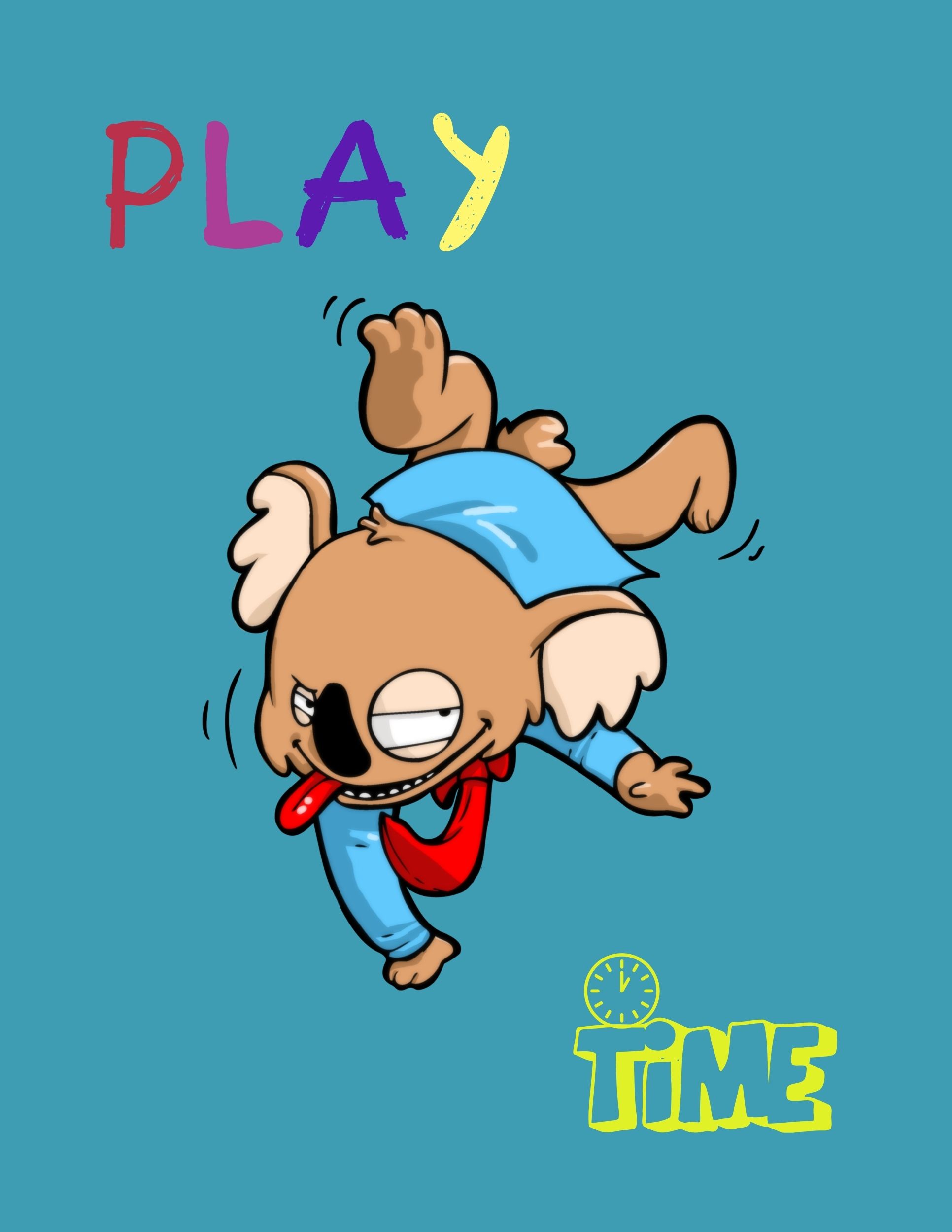
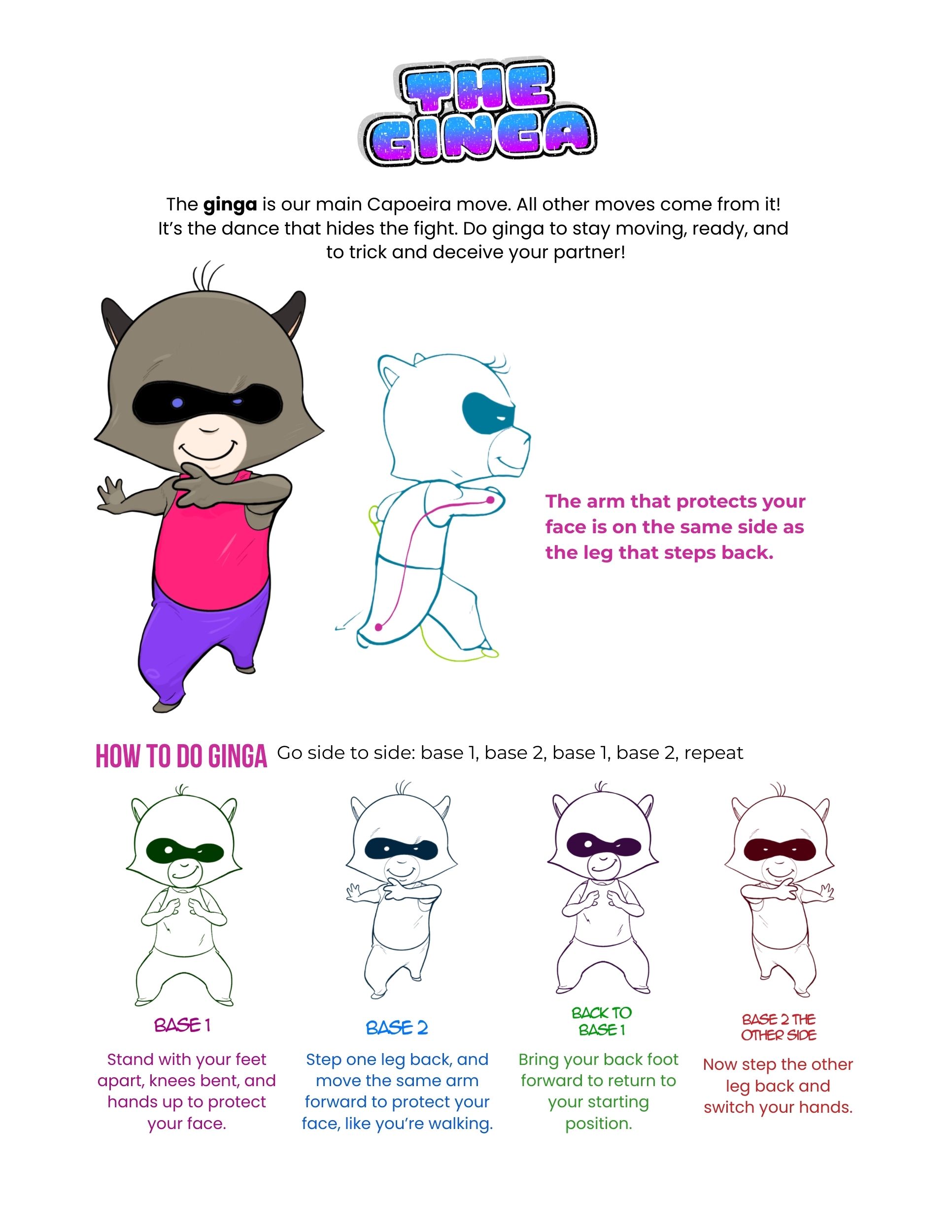
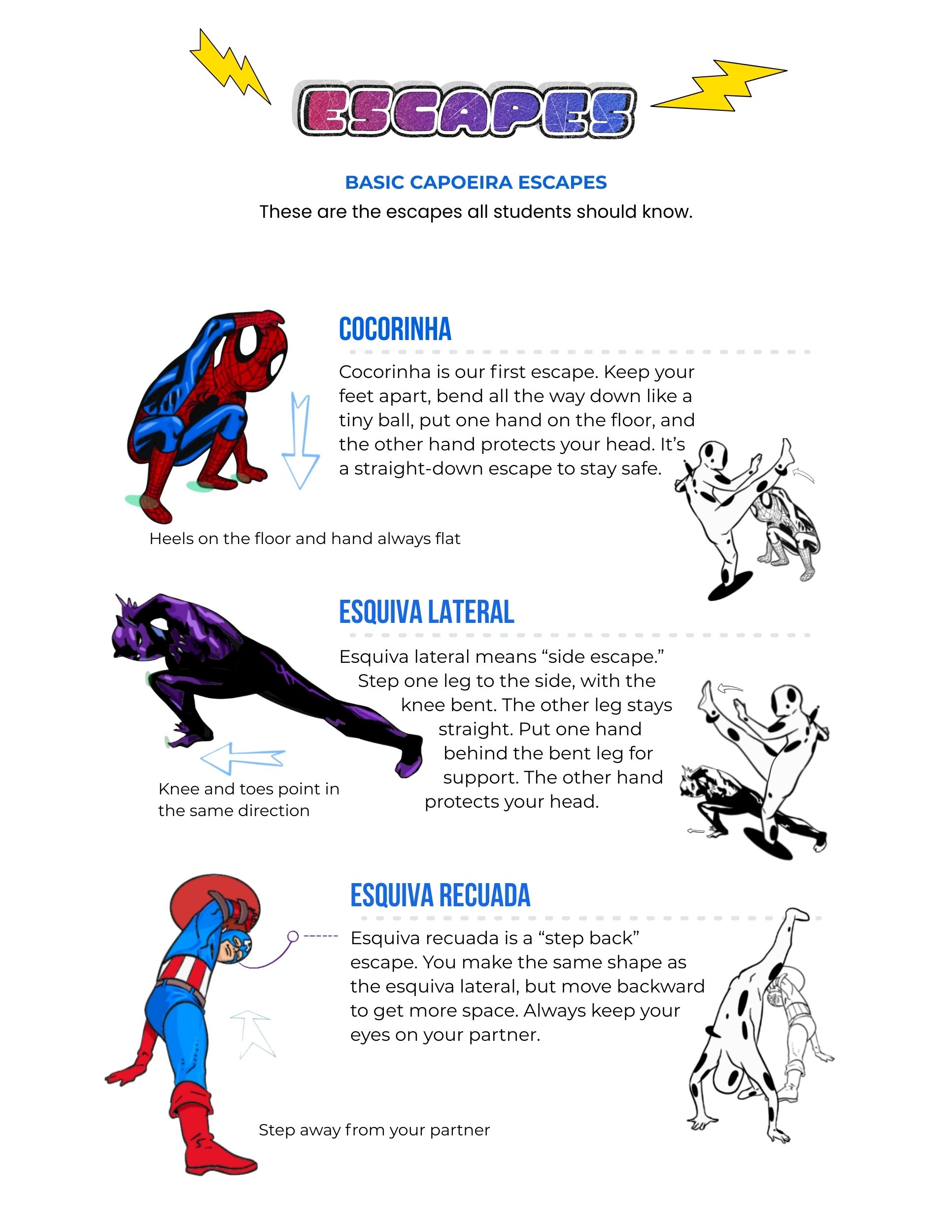
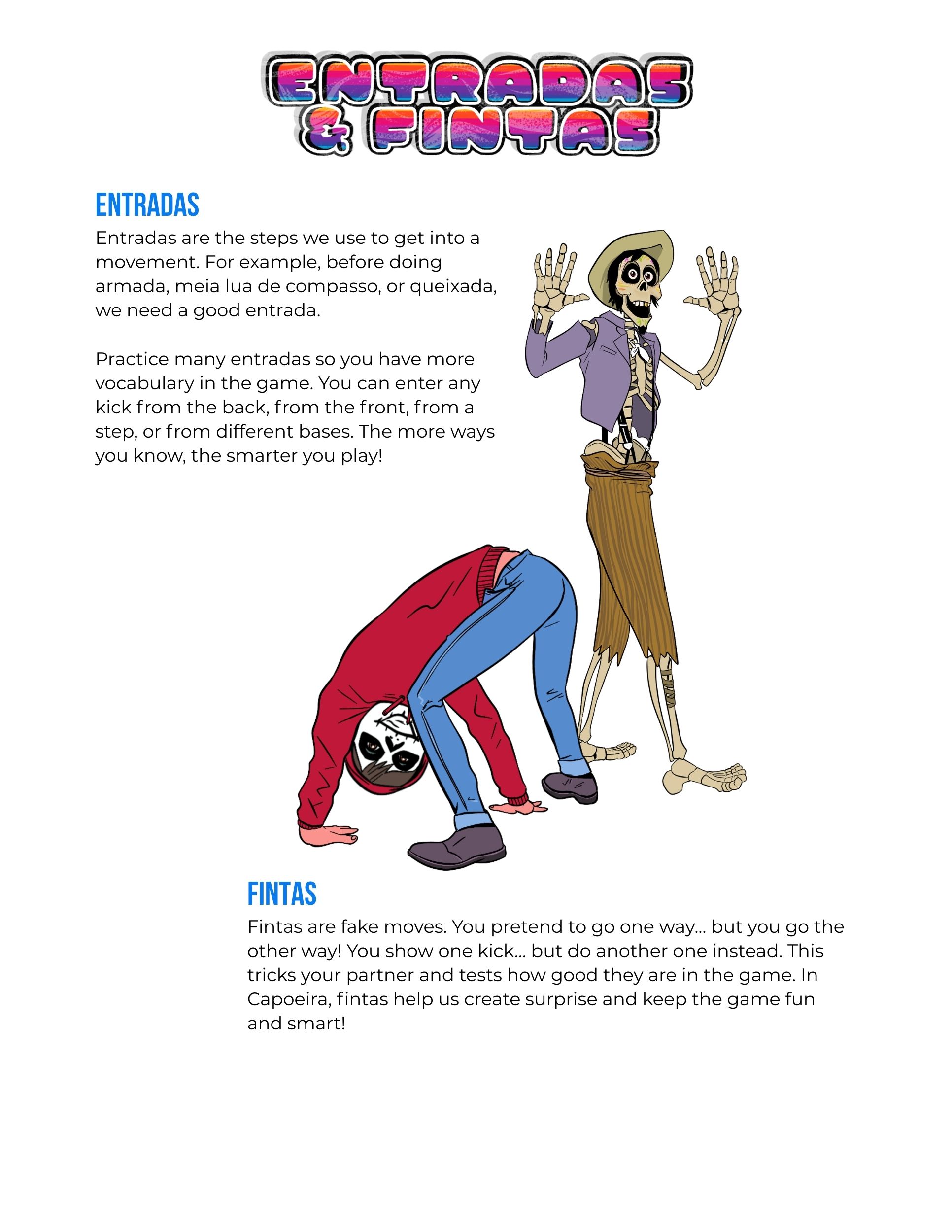
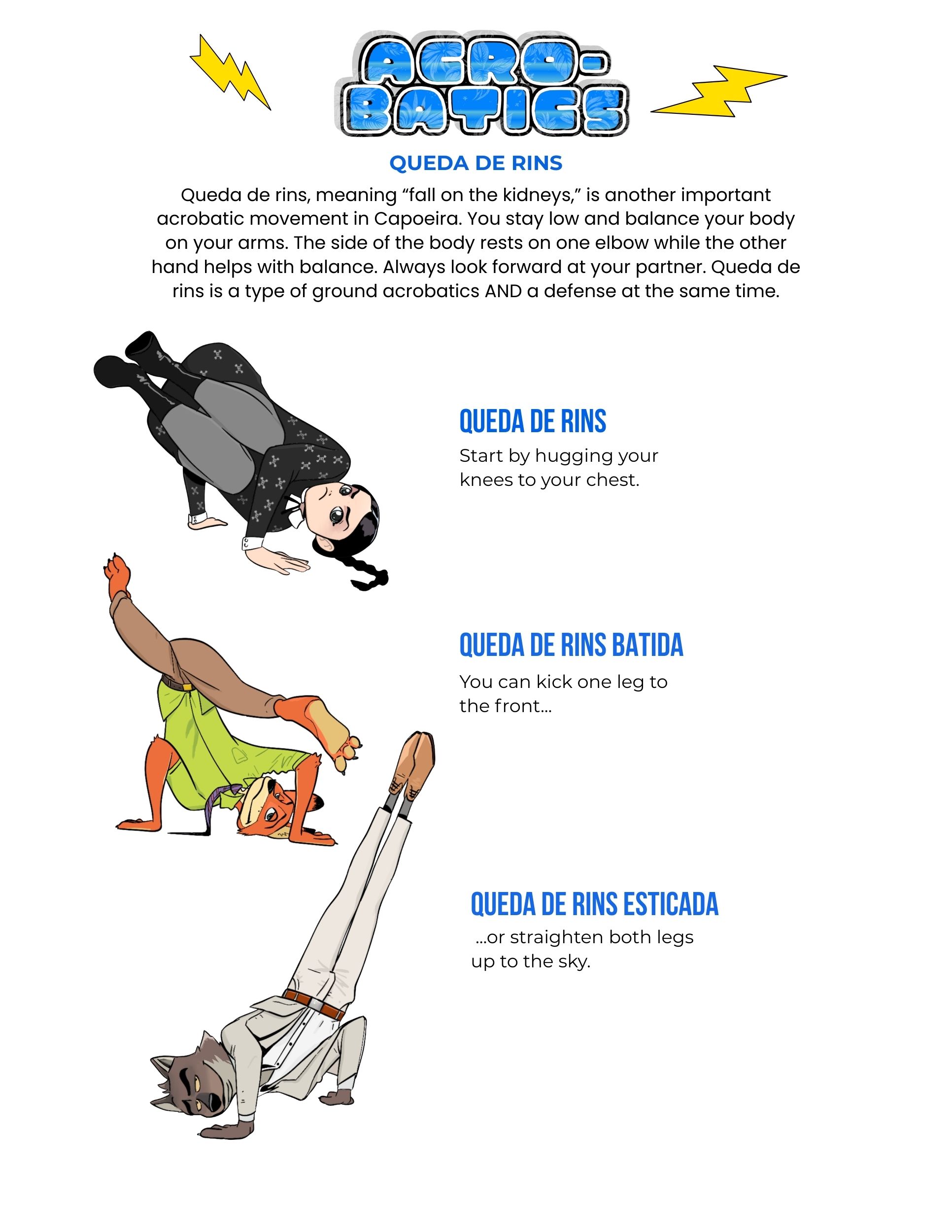
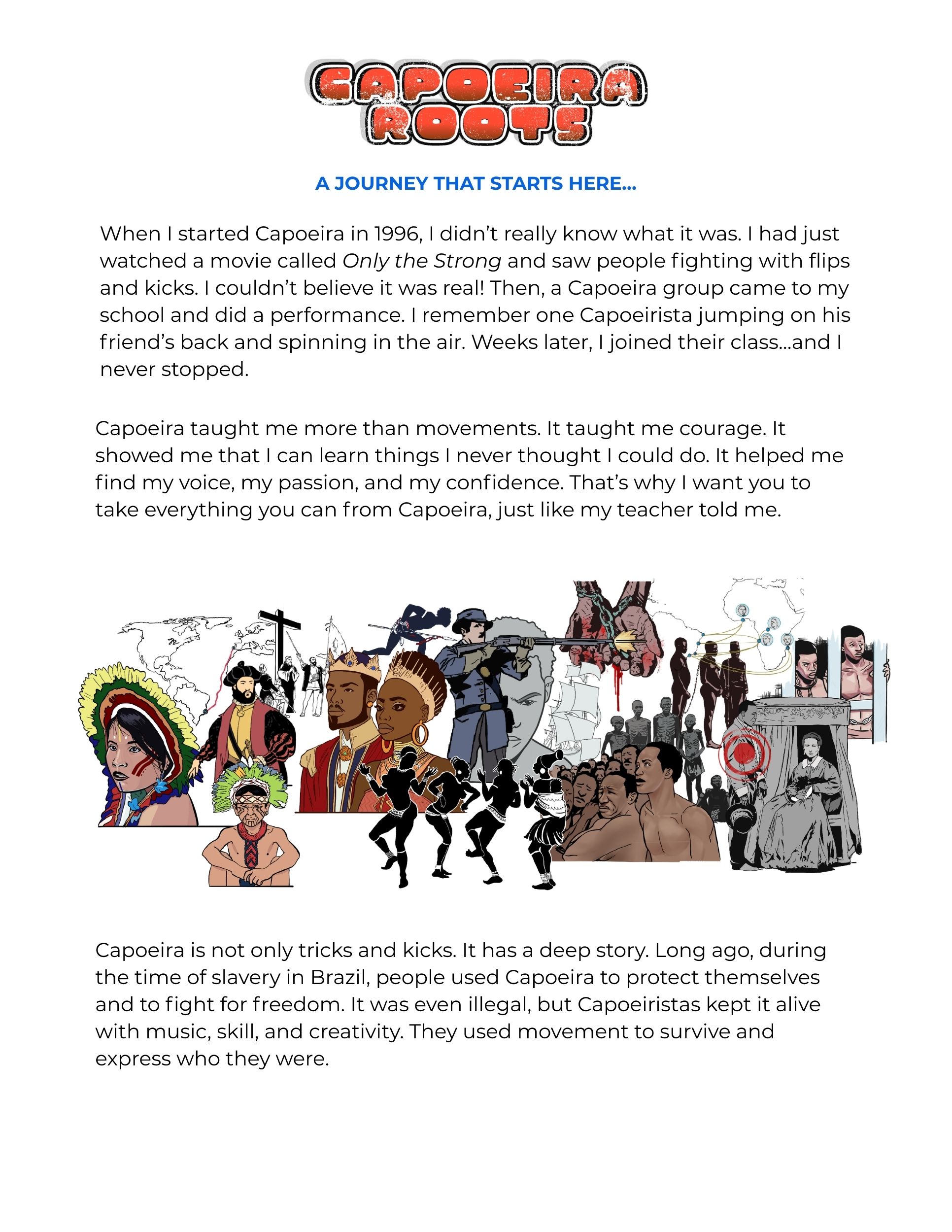
Every move your child learns in class is in this book. Every escape, every kick, every acrobatic. Drawn with superhero characters so kids actually want to read it. Explained clearly so parents understand what their child is working on.
Mestre Julio drew every illustration. Wrote every word. This is not a generic Capoeira book. It is the curriculum of this school, in a form kids can hold, read, and come back to.
Order online for $25 and save $10 vs the studio price. Pick up in studio or get it shipped.
-1_0766b89e.webp)
Get an extra $5 off the online price. Use this code at checkout and pay only $20 instead of $25:
Expires in 24 hours on this device.
Your Child's Journey Starts Here
No experience needed. Just show up. We take care of the rest.
Leave a Google Review
If your child trains with us, your feedback helps other families find us. It takes 60 seconds and means the world to our community.
Leave a ReviewOne Free Month. Parents Only.
Parents of current students can try a full month of adult Capoeira classes at no cost. Message us on WhatsApp to claim it.
Claim Free Month on WhatsAppQuestions? Reach out to us directly. We are happy to talk through what is right for your child.